• E- Learn CBM
  • About the Module
  • About the ModuleH
  • SECTION 1:Concept
  • SECTION 1:Concept Hindi
  • SECTION 2:Process
  • SECTION 2:Process Hindi
  • Section 3: Practice
  • Section 3: Practice Hindi
  • Section 4: ADVOCACY
  • Section 4: ADVOCACY Hindi
  • Dictionary
  Community Monitoring in Health Resources for the Practitioner

The Principles of Community Enquiry

Community enquiry involves the systematic application of methods deriving from both research and participatory appraisal. Along with other participatory methods it shares the spirit of putting the community at the centre of the process, giving members of the community not only an opportunity to put their opinion and experiences forward but also participate in the process of designing the enquiry process, generating data and also in the analysis process. These methods are designed to allow local communities identify their priorities and make their own decisions. Some questions that could be raised during the design and conduct of the community enquiry process which would enable more effective community participation and ownership, along with some suggestions for what could be done, are given below:
  • Are the community engaged in identifying the key issues for enquiry. Did they participate in finalizing the issues?
Some ways in which the community can be active in identifying the issues for enquiry is to have group discussions on health during the community scoping/health mapping exercise. The informal leaders/ members of any group that are formed during the scoping/mapping exercise can discuss the different issues that are identified and prioritise the key issues that they wish to include in the community monitoring/ advocacy process. It is useful to remember that the issues identified should be somewhat amenable to advocacy based improvement, and not intractable policy problems. The method of community monitoring allows issues related issues to be resolved through mutual negotiation between community and the providers and also allows the community and the providers to become partners in asking for those problems which require action at a higher level.

  • Do the methods of enquiry allow the key community to contribute their experiences during the enquiry process?
Communities can best relate their experiences through stories. The enquiry process should have adequate space to collect stories to illustrate the points that are being made through the more quantitative components of the enquiry. There should also be space within the more formal methods like in-depth interviews and focus group discussion to include these stories. While recording/ reporting stories, care should be taken to include specific information related to different policy/entitlement parameters/standards which form the basis of the enquiry framework.  When stories are collected, try to assess which service(s) did not meet government standards and why.

  • Do the methods of enquiry allow members of the community to participate in gathering and analyzing the data?
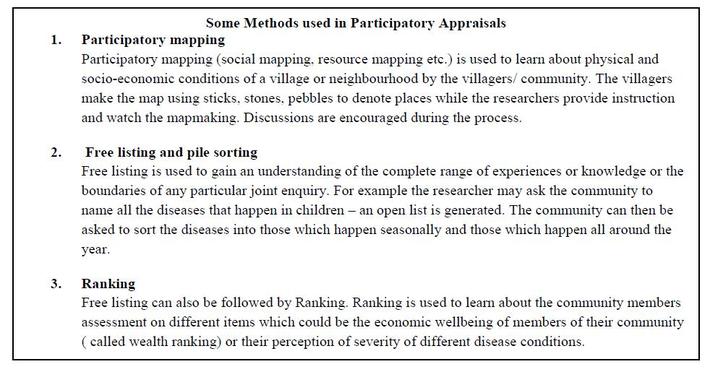
Community participating in data gathering and analysis can be encouraged through including some members of the community, particularly members of any community groups that have been energized during the mobilization process to be part of the enquiry team. A second way to involve communities in the enquiry process is to use methods which allow greater community participation like exercise based group discussions. These exercises can be drawn from PRA/PLA methods like social mapping, ranking, pile sorting, Venn diagrams etc. These methods usually allow even low and non-literate community members to actively engage in the analytic process. In order to involve the community in the quantitative collation processes the responses from interviews and group discussions can be summarized in simple collation sheets which can then be added, multiplied or divided to arrive at scores and traffic lights. The process is explained in greater detail later on.   

Picture
  • Do the methods of analysis allow the community to incorporate its own perspective into the report card to make the report card not only community generated but community owned?
In order that a community own and identify closely with a community enquiry process, the community must endorse the report card as representing their own collective story / experience. The different points discussed above contribute greatly towards building this ownership.  Before the report card is shared with other stakeholders like the Municipal authorities or the health providers, the card is shared with the community group that has already been mobilised or with a number of persons from the community who contributed to the enquiry process (participated in the interviews or group discussions). They are presented with the results of the enquiry – both the traffic lights and the more narrative explanation based on the stories and other details. Once the group endorses the report card one or more among them can also be requested to be part of the report card presenting team during the formal public sharing process Care must be taken that individuals who have contributed their stories and experiences to justify and explain any point in the report card do not become vulnerable to reprisal from the authorities. So their names must be kept anonymous at all times. 
Powered by Create your own unique website with customizable templates.